Nonverbal communication is a
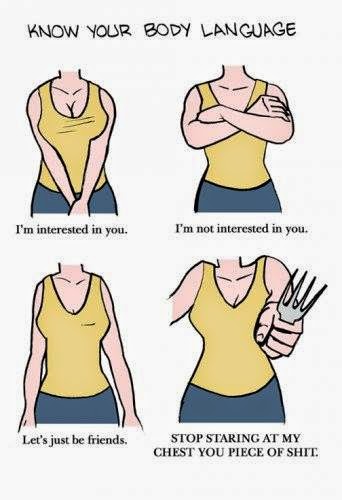
communication without involving words BUT expressions, body languages,
gestures, movements, external factors (the way we dress).
Benefits of nonverbal communication
1.You can communicate with someone who is deaf or
weak at hearing.
2.You can communicate at places where you are
supposed to be silent.
3.You can communicate something which you don’t
want others to know or listen.
4.You can communicate when you are far apart in
particular distance.
5.It makes you conversation short and sweet.
The
functions of Non-Verbal Communication
1.Integrating Non-Verbal Messages
Non-Verbal Messages may be used
to form or complement impressions, both made to and from you.
·To accent or emphasize the verbal messages
·To complement or add nuances of meaning to
verbal messages
·To contradict the verbal messages
·To regulate or to try to control verbal messages
·To repeat or relate the verbal message
nonverbally
·To substitute for verbal messages
2.Forming and Managing Impressions
·To be liked
·To be believed
·To avoid failure
·To secure help
·To hide faults
·To be followed
·To confirm self-image and to communicate it to
others
3.Defining relationship
Non-verbal communication (NVC) and gestures
are used in various stages of relationships
For example:
I.To employers, you tend to look professional and
likeable.
II.To normal friends, you tend to be casual,
communicating in a more openly way.
III.To best friends you could go crazy.
IV.Dating with your girlfriend or boyfriend
4.Structuring Conversation
5.Influencing and Deceiving
NVC can be used to influence others into
believing at the same time distracting others.
6.Express Emotions
The Channels of Non-Verbal Communication
· Body
Messages
·Body Appearance
·Facial Communication
·Eye Communication
·Spatial Messages
·Artifactual Communication
·Smell Communication
·Touch Communication (Haptic)
·Paralanguage
·Silence
·Time Communication (Chronemics)
Culture and Non-Verbal Communication
·Culture and Gestures
·Culture and Facial Expression
·Culture and Eye Communication
·Culture and Non-Verbal Communication
How does a
blind man communicate with a deaf man?
Avariety of ways, depending on the individual.
They can, and do, use sign language. For those that use sign language, you will find
that they either use tactile signing or close-vision signing depending on how
much vision they have, or what kind of vision loss. Close vision signing involves the deaf-blind
individual being close to the signer, and often they will hold onto the wrists
of the signer in order to make it easier to see and track the signs.
Tactile signing involves signing into the hands
of the deaf-blind person.
For Example: Helen Keller.
In a nutshell, in our everyday
life, most of us uses verbal messages and goes along with non-verbal messages.
Though we don’t pay much attention on this, people are studying us on how we
behave. It is important to how we control ourselves for the sake of our well-being.
Being happy and yet not showing any signs of happiness don’t make sense at all,
the picture is not complete. Besides that, culture plays an important part in
our life because if we tend to be practicing Japanese culture in Malaysia, it
will look unpleasant, same goes to the opposite way. So, body languages and
verbal communication normally come together in a way to express ourselves. If
there’s only verbal communication, our message can’t be understood by others in
a more proper manner.
Through our basic understanding, verbal
communication is a way of conveying information in a spoken rather than written
manner or it is acommunication
that uses words, either written or spoken.
"Verbal" is sometimes used conversationally in the sense of
"spoken", but it is better to use "oral" in that context,
to avoid uncertainty. Besides that, verbal messages are also to convey
effectively to receiver for understanding or agreement.
PRINCIPLES OF VERBAL MESSAGES
1. Meanings Are in People
It’s in this sense that meanings are not in words, but
in people. Consequently, to uncover meaning, you need to look into the
people and merely into words.
BYPASSING – the miscommunication pattern which occurs when the
sender and receiver miss each other with their meanings.
Basically, bypassing can be in
two forms:
1. Different individuals communicating
using different words, but has the same meaning.
Everyone on this planet has their
own perspectives in the sense of almost everything,however, some individuals
have the same perspective or thinking but they interpret it in a unique way.
Example 1: Jack: I hate April fool’s day because I'm really gullible.
Jane: April fool’s day is never my day.
From this example
given above, it meant that Jack and Jane doesn’t like April 1st
because somebody made fun of them and ruined their day.
Example 2:
6+3=9 so does 5+4 and 7+2.
Everything has a way
to solve it, it is either you do it this way or the other then you end up
having the same answer or goal.
2. Two individuals communicating using the
same words, butdifferent meaning.
On the surface, it
looks like two people agree on certain things, but if it is looked carefully;
they may seem to have different meanings.
For example:
Mark: I don’t really believe in religion. (He meant that he doesn’t believe in
God.)
Tim: Neither do I. (But he meant that he doesn’t believe in organized
religions.)
2. Languages are Denotative and
Connotative
Denotative the word’s meaning taken from dictionaries.
Connotative the word’s subjective or emotional meaning.
Snarl words: words used to describe
people in a highly negative way. (Idiot, stupid, loser) Purr words: words used to describe
people in a highly positive way. (Sweetheart, honey)
These are pretty much what we are doing
in our daily life, calling people names and stuffs.
Denotative
Connotative
Green
·A colour between yellow
and blue.
·The colour of leaves,
grass and plants.
Green
·This is the colour of balance
and harmony. From a colour psychology perspective, it is the great balancer
of the heart and the emotions, creating equilibrium between the head and the
heart.
·The
symbol of ecology and a verb.
3. Meanings Depend on
Context/Abstraction
The same words or behaviours may have
totally different meanings when they occur in different contexts. Similarly,
the meaning given signal depends on the other behaviour it accompanies or is
close to in time. In isolation from the context, it’s impossible to tell what
meaning was intended by merely examining the signals. Of course, even if you
know the context in detail, you still may not be able to identify the meaning
of the message.
For example, pounding a fist on the
table during a speech is support of a politician means something quite
different from that same gesture in response to news of a friend’s death.
4. Messages Vary in Politeness
Politeness and Directness
·Polite messages reflect
positively on the other person and respect the other person’s right to be
independent and autonomous.
·Direct messages are usually
lee polite compared to indirect messages.
For example:
Direct messages: This dish tasted awful!
Indirect messages: I would like to order another dish; this isn’t my cup of
tea.
5. Messages Vary in Assertiveness
Assertive people tend to operate an ‘I
win, you win” philosophy, they assume that both parties can gain something from
an interaction, even from a confrontation. Assertive people are more positive
and score lower on measures of hopelessness than do non-assertive people.
Communicating Assertiveness
1.Describe the problem
2.State how this problem
affect you
3.Propose solutions
4.Confirm understanding
6. Messages can deceive
An act of sending messages with an intention
of giving people false information is called LYING.
4 types of Lying:
1.Pro-social deception – to
achieve some good
2.Self-enhancement deception –
to make yourself look good
3.Selfish deception – to
protect yourself
4.Anti-social deception – to
harm someone
Basically, this is the
first half of Chapter 5, discussing about the principles of verbal messages/
communication. From all these principles we can learn that verbal messages vary
in many ways, it could be positive and negative or satisfied and hurtful. So,
we may have to watch our words and try to be an indirect person as we can.
The following topics
we are about to discuss are the responses we make and a wide variety of
offensive language practices by viewing them as types of disconfirmation – as
language that alienates and separates.
Disconfirmation and Confirmation
Disconfirmation is a communication
pattern in which we ignore someone’s
presence as well as that person’s message. Moreover, this person and what this
person has to say are not worth serious
attention or effort that this person and his person’s contribution are
unimportant or insignificant and that there is no reason to concern ourselves
with her or him.
Disconfirmation IS NOT the same as rejection. Rejection can
be defined as you disagree with the
person and you indicate your unwillingness to accept something the other person
says or does.
Confirmation involves your
acknowledging the presence of the other person, the person’s importance and
your acceptance of this person.
Racism
Anything that makes race looks inferior
to the other races.
This is one of the examples happened in
Australia. Joseph, who looks like an Indian were being bullied in his
neighbourhood.
These are just examples, there are still
tons of these cases happening in multi-races country, for obvious example:
Malaysia, USA, Australia, Indonesia, Thailand and so on.
Before these racism cases increase to an
unimaginable level, we really need to stop it by avoiding it.
Steps:
1. Make friends that are different from your
racial or ethnic background.
2. Promote diversity
3. Be friends with other non-racists.
4. If you get into an argument with someone of another race, don't use racial
hatred.
5. Avoid interacting with members of other races through stereotypes
perpetuated by the media.
6. If anyone close to you is a racist encourages them to think differently by
letting them know that you don't approve of their opinions and hateful
activities.
Heterosexism
Heterosexism is some sort of
discrimination in favour of
opposite-sex sexuality and relationships and it includes the obvious derogatory
terms used for lesbian and gay men.
Here are some ways we should avoid heterosexism:
1. No hate speech. This includes use of derogatory words
toward any one group. So: you can't go cursing out straight, gay, trans, Bi,
etc. people. 2. No flame wars. Do not just respond to attack
another person's opinion. If you have an intelligent, constructive response,
that follows the rules, and answers the question, you're welcome to mention the
answer you're responding to. 3. Avoid complimenting gay men and lesbians
saying “What a waste!” is obviously not a compliment.
4.Avoid denying individual differences like “Gay men are so open with their
feelings.”
Ageism
Ageism isstereotypingand
discriminating against individuals or groups on the basis of their age.
Ageism can be avoided by:
1. Avoid talking down to or refreshing an older person’s memory.
2. Avoid implying that relationships is no longer important. They are still
interested in relationships
3. Engage older people in conversation as you would wish to be engaged.
Sexism
Sexismorgender
discriminationis prejudice
or discrimination based on a person's sex or gender.
Sexism can be avoided by:
1.An employer should
avoid making employment decisions on the basis of gender.
2.Both males and females should be given an equal opportunity to qualify for an
open position provided the candidates have the same qualifications.
3. All employment policies should be applied in a gender-neutral manner.
4. Equal salary and benefits should be given to both men and women who
demonstrate substantially equal skill, effort and responsibility under similar
working conditions.
Using Verbal Messages Effectively
1. Messages can symbolize reality
Messages are often
used to represent the things, and therefore, we must aware that messages do not
just representing the reality BUT symbolizing it.
For example:
When one of your
friends recommended you to try out one particular brand because of the fame,
but not the quality(reality), you simply made a decision to buy it because you
believed what they said (symbol).
2. Messages express both fact and inference
The messages we
deliver often infused with our emotion, thoughts and feelings, therefore it can
be misleading at times on the content of the message.
For example:
“I love sports”
(Factual Statement)
“I dislike other activities besides sports” (Inferential Statement)
3. Messages can be relatively static
Terms and words we
used are formed through our own perception and judgement, but how often we
update our perception?
4. Messages can obscure distinction
Messages can be
confusing and somehow misleading.
Indiscrimination
The failure to
distinguish between similar but different people, objects or stereotyping.
Example: Linking every Muslim to be a terrorist in this world
Polarization
The tendency to
look at the world in terms of opposites and then exaggerating it.
Example: Not allowing the possibility of middle ground.
In short, verbal messages are important to every mankind, it brings many
advantages to mankind. However, some people tend to be different in the way
that actually saddened people, like criticizing. But there are ways to overcome
it and avoiding it. We need to put into practice, so that we can live in a
better world!
Tuesday, 1 April 2014
Activity
High Self-esteem VS Low Self-esteem
People with high self-esteem:
1. Believe in themselves
2. Know what they want or need
3. Effective communication skills
4. Drive to succeed
5. Comfortable with change
6. Enjoy healthy relationships
7. Goal-oriented
8. Able to laugh at their self
9. Taking care of themselves physically, emotionally, mentally and spiritually.
People with low self-esteem
1. Lack of self confidence
2. Social withdrawal
3. Anxiety and emotional turmoil
4. Lack of social skills
5. Inability to accept compliments
6. Lack of willing to take challenges
7. Lack of trust on their own opinion
8. Less social conformity
The area of
‘self’ can be explored and widen into 4 types , which is:
(a)Self-concept
(b)Self-awareness
(c)Self-esteem
(d)Self-disclosure
(a) Self-concept
Self-concept
is your image of who you are, it’s how you perceive yourself: your feeling and
thoughts about your strengths and weaknesses, your abilities and limitations.
There are some components of the self-concept.
(1) Others’
images of you
Looking-glass
self: we’d look at the image or ourselves that others reveal to us through the
way they communicate with us. We would look to those who are most significant
in our life, such as family members, friends, and romantic partners.
(2)
Comparisons with others
We compare
ourselves with others, most often with our peers. This gives us a clearer idea
of how effectively we performed. We will gain different perspectives when we
see ourselves in comparison to our peers.
(3)
Cultural teachings
Our culture
instills in us a variety of beliefs, values, and attitudes about such things as
success. Our ability to achieve what our culture defines as success, whereas
our failure to achieve what our culture encourages contributes to a negative
self-concept.
(4)
Self-interpretations and self-evaluations
Self-interpretations
are our reconstruction of the incident and our understanding of it.
Self-evaluations are the value that we place or the behavior. Self-interpretation
and self-evaluation are our standards that apply to our ethical and moral
reasoning, beliefs and comprehension and conformity of things around us.
(b) Self-Awareness
Self-awareness
is the knowledge of who you are, of your traits, your strengths and
limitations, your emotions and behaviors, your individuality, it is basic to
all communication. Johari window, is a metaphoric division of the self into
four areas.
(1) Open
self
This self
represents all the information, behaviors, attitudes, and feelings about
ourselves that we know and that others also know. This size of the open self
varies according to our personality and the people whom we’re relating.
(2) Blind
self
This self
represents knowledge about us that others have but you don’t. It’s important to
reduce our blind self and learn what others know about us.
(3) Unknown
self
This self
represents those part of ourselves that neither you nor others know. This is
information that is buried in our subconscious.
(4) Hidden
self
This self
represents all the knowledge we have of ourselves but keep secret form others.
We should try to increase awareness of our own needs, desires, habits, beliefs,
and attitudes. Here are some various ways:
(a) Listen to others (c)
Seek information about ourselves
(b) Increase our open self (d) Dialogue with
ourselves
(c) Self-EsteemSelf-esteem is a measure of how valuable we think we are. People with high self-esteem think very highly of themselves, whereas people with low self-esteem view themselves negatively. The basic idea behind building self-esteem is what when we feel goof bout ourselves. Here are five suggestions to increase self-esteem. (1) Attack self-destructive beliefs -Challenge beliefs you have about yourself that are unproductive or that make it more difficult for you to achieve your goals. -self-destructive beliefs set unrealistically high standard and therefore almost always lead to failure. (2) seek out nourishing people -Nourishing people are positive and optimistic. They also reward us, they stroke is, they make us feel good about ourselves. -Identification with people similar to us also seems to increase self-esteem. (3) Work on projects that will result in success. -We should select projects that will result in success. Each success will help build self-esteem. -Each success will make the next success a little easier. (4) Remind yourself of your successes -We should focus on correct what we did wrong or identify the skills that we need to correct these failures. Focusing on failures can have some positive value. (5)Secure affirmation -We should remind ourselves of our successes with self-affirmation that we focus on our good deeds, our positive qualities, strengths, and virtues.
(d) Self-disclosureSelf-disclosure is a type of communication in which we reveal information about ourselves that we normally keep hidden. There are some factors that influence self-disclosure. (1) who you are-Highly sociable people vs less sociable people (2) Your culture- Different culture (3) Your gender- Males vs females (4) Your listeners- small groups, normally a groups of two people. (5) Your topic and channel- information that we likely to disclosure




.jpg)


